Project Celsius

Strategic Fleet Expansion & Autonomous Deployment Model

Confidential • Authorized Personnel Only

PROJECT CELSIUS
Temperature-Controlled Transportation

The Platform

A scaled, asset-based, temperature-controlled transportation and logistics platform with $1.0B annual revenue, 3,000+ power units, and a multi-decade operating history serving America's essential supply chains.

Investment Thesis
A rare opportunity to invest in a scaled, essential-services transportation platform at a cyclical inflection point. The foundation is proven—Project Celsius represents the next evolution: applying Precision Scheduled operations to unlock margin expansion, autonomous readiness, and a path to $5B+ in revenue.

Platform At-a-Glance

~$1.0B
Annual Revenue
~3,000
Power Units
~5,000
Trailers
~4,000
Team Members
286
Active Customers
48
State Coverage

Three Complementary Divisions

Over-the-Road (OTR) Refrigerated

Largest Division

Long-haul, temperature-controlled freight serving protein, produce, grocery, beverage, pharmaceutical, and high-value cargo. Emphasis on safety, compliance, and reliability.

Dedicated Transportation

Highest Margin

Customized, multi-year contracted fleets for large customers. Predictable revenue, strong pricing power, and low churn. Focus area for expansion: 800 → 2,000+ trucks.

Logistics & Brokerage

Asset-Light

Asset-light brokerage and freight management. Enhances customer stickiness and network efficiency. Provides flexibility during market volatility.

Expedited Network

Future Star

Precision Truckload operations applying scheduled railroading principles to highway freight—engineered for time-definite reliability, network velocity, and autonomous readiness. Early results show 22-point OR advantage over traditional OTR with 2x operational velocity.

Downside Protection: Dedicated services represent ~30% of revenue, providing stability through freight cycles.

Market Opportunity

U.S. Reefer Market (2023) TAM
Market Size $27.5B
Highly fragmented, largest player ~5% share
Projected CAGR Through 2029
Growth Rate ~7.8%
Essential goods demand driving growth
Revenue Target 7-10 Years
Organic + M&A $5.0B
5x growth through consolidation

Competitive Advantages

Scale & Network Density (48 states)
Best-in-Class Safety (CSA scores)
10-25+ Year Customer Relationships
Driver-Centric Culture & Retention
Cloud TMS & AI Safety Systems
Autonomous Vehicle Pilot Participant

Enter Project Celsius

The Expedited Network: Where Foundation Meets Future

Project Celsius transforms this proven platform into something unprecedented: a Precision Truckload operation applying scheduled railroading principles to highway freight. The existing OTR infrastructure provides the scale, customer relationships, and operational expertise. Celsius adds the network design, cadence discipline, and autonomous readiness that unlock the next tier of margin and growth.

From OTR Baseline
108 OR, 23 mph velocity, reactive dispatch
To Expedited Model
86 OR, 45 mph velocity, scheduled precision

Three-Lever Growth Strategy

1

Organic Growth

Expand Dedicated fleet from ~800 to 2,000+ trucks. Customer penetration and share expansion. Pricing recovery as capacity rationalizes.

2

Strategic M&A

Target 4-6 mid-sized or 1-2 large acquisitions. Focus on succession issues, under-optimized operations, capital constraints. Pre-screened pipeline across regions.

3

Operational Excellence + Technology

Cost synergies from scale. Network optimization. Technology-enabled productivity. Autonomous and semi-autonomous initiatives over medium term.

Financial Profile & Returns

Historical EBITDA Margin Baseline
Margins Mid-Teens
Temporarily pressured by industry conditions
2027 EBITDA Forecast Base Case
Organic Only ~$295M
OR improving to high-80% range
Illustrative IRR Strategic
Range 15-30%+
2.0x - 5.0x+ MOIC under growth scenarios
Recapitalization: ~$500M new equity contemplated to accelerate growth and acquisitions. Multiple exit paths: strategic sale, PE recap, public listing, or long-term hold with cash yield.
Celsius Expedited Network

Precision Truckload

An engineered, time-definite operating system applying Precision Scheduled Railroading (PSR) principles to highway freight. Not a traditional trucking operation—a network designed for repeatability, cadence, and velocity.

FREIGHTMATH DASHBOARD
Core Thesis
Just as PSR revolutionized rail by shifting focus from "moving trains when full" to "moving trains on a schedule," the Celsius "Precision Truckload" model prioritizes network velocity and disciplined cadence over opportunistic freight acceptance. Time-definite reliability is manufactured through deliberate design choices—committed Expedited Lanes, rigid schedules, and repeatable operating procedures.

Key Highlights

Proven Performance: Expedited vs. OTR

Data period: October 25, 2025 – January 10, 2026 (post volume expansion)

Operating Ratio 22.4pt Advantage
Expedited 86.2
vs
OTR 108.6
Efficiency-driven margin, not premium pricing
Operational Velocity 2x Faster
Expedited ~45
vs
OTR ~23
mph — Drastically reduced tractor dwell time
Deadhead Percentage 3.5pt Lower
Expedited 13%
vs
OTR 16.5%
Tighter freight-to-capacity matching
Key Finding: While OTR commands higher Yield (revenue per loaded mile), it fails to convert that advantage into Margin. OTR profitability is eroded by operational friction—dwell, variability, and market pricing pressure. The Expedited Network converts revenue to profit more efficiently through schedule discipline and asset utilization protection. This comparison indicates the "financial prize" available to Celsius.

Current Network Footprint

Active Lanes & Capacity

Los Angeles Dallas
24 trucks
Laredo Dallas
16 trucks
Indiana North Carolina
8 trucks
Indiana Pennsylvania
8 trucks
Texas Kansas
4 trucks
Indiana Kansas
4 trucks
Total Active Capacity 64 trucks

Node Status

Operational
Los Angeles (San Bernardino) Indianapolis (Terminal) Memphis Oklahoma
Immediate Needs
Dallas (Capacity expansion) Kansas City (Site expansion) Laredo (Yard agreement pending) Carlisle, PA (New leased lot)
Future Evaluation
South Atlanta Oregon Salt Lake City Las Vegas Denver
Rule #1: Do Not Drift

Avoid accepting opportunistic freight that degrades network velocity, regardless of external market rates. A line must be drawn in the sand.

Rule #2: Fund the Nodes

Accept that infrastructure is a core operating cost and fund it ahead of the curve to prevent bottlenecks.

Ultimately, Celsius is building a machine that converts Miles into Margin more efficiently than any competitor. The near-term goal is to scale this machine while protecting the discipline that makes it profitable.

SWOT Analysis

Click each section to expand full details

Strengths 6 factors
Superior OR (86.2) Intentionality Standard 2.3x Velocity +3 more
Superior Financial Performance
The network is demonstrating an Operating Ratio (OR) of 86.2 versus the OTR network's 108.6. This is achieved through efficiency rather than premium pricing.
The "Intentionality Standard"
A disciplined operating model that prioritizes engineered commitments, defined schedules, and repeatable processes over daily optimization or opportunistic freight acceptance.
Operational Velocity
Significantly higher velocity (~45mph) compared to OTR (~23mph), driven by lower deadhead (13% vs 16.5%) and better freight-to-capacity matching.
Experienced Leadership
Led by an executive with a proven playbook for designing scaled expedited networks, ensuring governance and preventing scope creep.
Risk-Mitigated Growth Strategy
The "Incubation Process" uses OTR assets to validate lanes and freight behavior before committing dedicated expedited capacity, reducing upfront capital risk.
Engineered Seasonality
Rather than reacting to produce shifts, the network embeds seasonal lane maps and launch-point adjustments (e.g., shifting origin from Mexico to California) into the design.
Weaknesses 4 factors
Infrastructure Gaps High-Consequence Sector Financial Blind Spots +1 more
Infrastructure Gaps
The current physical network requires significant expansion to support the engineered model. Specific needs include capacity expansion in Dallas, a larger site in Kansas City, and a new yard agreement in Laredo.
High-Consequence Environment
Operating within the refrigerated truckload (TL) sector introduces higher variance and higher penalties for failure compared to dry van networks.
Early Build Phase Maturity
The network is still in the early stages, relying on a limited number of active lanes (6 active corridors), limiting broad geographic reach.
Financial Modeling Blind Spots
The current "Expedited Calculator" and financial planning approach risks overstating immediate profitability:
Infrastructure "Burden": The model recognizes infrastructure (yards, security, terminals) as existing "sunk costs" rather than variable costs necessary for growth. Without detailed analysis, proforma net margins are inflated. If a new lane requires a leased drop lot in Carlisle, PA to function, that lease cost must be allocated to that lane's unit economics.
Autonomous CAPEX Shock: Modeling autonomous trucks simply as "labor savings" without accounting for significantly higher upfront acquisition cost (technology hardware + software licensing + integration). This creates a Cash Flow Trough in early stages—while OPEX drops, CAPEX spikes.
Accelerated Asset Depreciation: Assuming standard 4-5 year useful life while projecting "autonomous utilization" levels. The "Force Multiplier" effect means trucks running 200,000+ miles/year vs 100,000 miles/year—compressing a 4-year truck into a 2-year truck. Monthly depreciation expense must double to match accelerated consumption, otherwise creating a "profit mirage."
Opportunities 5 factors
AV Force Multiplier Geographic Expansion Pricing Power +2 more
Autonomous Trucking Integration
Autonomy is identified as a "force multiplier." It offers the potential to break human hours-of-service, remove other 'friction costs' (e.g. idling, out-of-route mileage, maintenance compliance), increase effective utilization, and reduce cost-to-serve through continuous operation.
Geographic Expansion
Evaluation is underway for new nodes in South Atlanta, Oregon, Salt Lake City, Las Vegas, and Denver, which would densify the network and reduce execution risk.
Future Pricing Power
While currently relying on efficiency for margin, establishing a reputation for time-definite reliability will allow Celsius to command premium pricing when the broader truckload market cycle turns favorable.
Take-or-Pay Structures
Moving customers toward "intentional volume commitments" and take-or-pay constructs can stabilize revenue and insulate the network from market volatility.
Counter-Cyclical Competitive Positioning
While the industry has paused investment due to prolonged freight recession, Celsius is accelerating. By coupling counter-cyclical asset acquisition with the "Precision Truckload" operating system, Celsius is doing more than just gaining market share—it is defining a new category. This engineered approach creates separation from traditional "opportunistic" carriers, effectively carving out a proprietary niche where reliability is a product of design, not just driver effort.
Threats 4 factors
Operational Drift Market Environment Shipper Compliance +2 more
Operational "Drift"
The risk that sales, operations, or pricing teams revert to "opportunistic freight acceptance," which would erode the cadence and utilization that make the model profitable.
Market Environment
The current truckload market does not support premium pricing, forcing the network to rely entirely on internal cost efficiency to generate margin.
Shipper Non-Compliance
The model relies heavily on customer behavior (appointment discipline, facility performance). If shippers fail to meet these engineered standards, the schedule integrity—and thus the profitability—collapses.
Infrastructure Constraints
If the necessary terminals and drop lots (the "physical operating system") are not acquired or funded in time, they will become the primary bottleneck to scaling, regardless of freight demand.
Autonomous Equipment Providers
AV technology developers may pursue vertical integration—partnering directly with shippers or acquiring carrier assets—to capture freight margin rather than selling technology to carriers. This disintermediation risk could marginalize traditional carriers who fail to secure early AV partnerships.

Expedited Network Overview

The Expedited Network operates within the Company's OTR temperature-controlled platform but functions as a distinct product. While it shares assets, it does not share the same operating philosophy. OTR seeks optimization; Expedited seeks repetition.

The structure mirrors Less-Than-Truckload (LTL) linehaul logic: scheduled departures, defined routes, and strict timing. However, this is executed in the high-variance environment of refrigerated truckload freight.

Density Efficiency
Efficiency Velocity
Velocity Profitability

The Precision Standards (Intentionality)

To prevent operational drift, the network enforces four engineered standards

01

Disciplined Customer Selection

Not all freight fits the network. Onboarding requires strict appointment discipline, specific yard processes, and agreed-upon escalation protocols.

02

Volume Commitments

Stability is achieved through "low-water-mark" volume protections and, where feasible, take-or-pay contracts.

03

Schedule Integrity

Lanes are designed with repeatable launch points and predictable cycle times. The mandate is to run the schedule, not just the load.

04

True Cost Attribution

The cost model must allocate specific expedited support costs (security, trailer positioning, yard labor) to the lane, ensuring leadership sees real unit economics.

The Incubation Process (Risk Mitigation)

Less speculation on capacity. The network grows through a staged "prove-it" process.

1. Selection

Identify high-potential lanes with consistent volume and committed customers.

2. Incubation

Run the lane using OTR assets first. This validates facility readiness, dwell times, and freight consistency without stranding expensive expedited assets. Earn while you learn.

3. Conversion

Only once the lane demonstrates repeatable cycle times and stable utilization, can it be marked for inclusion to the dedicated Expedited.

Operating & Commercial Requirements

Operations: Execute the Schedule

The goal is to move from "managing chaos" to "managing exceptions."

  • Standardized Recovery: Dispatchers use pre-set playbooks for disruptions rather than negotiating solutions daily.
  • Strict Thresholds: Defined triggers determine when to pivot capacity or reject freight to save the broader schedule.
  • Seasonal Transitions: Playbooks dictate exactly when lanes pivot and how capacity repositions, preventing decision paralysis during produce shifts.

Commercial: Contract for Behavior

In the near term, monetize reliability, not price.

  • Behavior over Rates: Prioritize contracts that enforce consistency—appointment adherence, cancellation penalties, and volume floors.
  • Mode Agnostic / Profile Specific: Utilize dry van freight to fill network gaps ("Universal Capacity"), provided the freight profile matches velocity requirements (e.g., drop-and-hook, no dwell).
  • Future Pricing: Premium pricing will follow proven reliability. Once network scale and reputation are established, and the market cycle turns, pivot to yield expansion.

Autonomous Trucking: The Force Multiplier

In the Celsius Expedited Network, autonomous trucking is not treated as a novelty or an experiment—it is the ultimate realization of the Precision Truckload thesis. The expedited network is engineered to reduce variability for human drivers; that same engineering makes it the ideal operating environment for AV technology.

While traditional carriers view autonomy primarily as a labor solution (replacing the driver), Celsius views it as an Asset Utilization Solution. The goal is to decouple revenue generation from human physiological constraints.

1. Operational Mechanics: The "Continuous Chain"

Standard OTR trucks are legally capped by Hours of Service (HOS)—an 11-hour driving window followed by a mandatory 10-hour reset. This effectively idles the revenue-generating asset for 50%+ of its available life.

The Hub-to-Hub Machine

AV units operate strictly on the long-haul middle mile (e.g., Dallas terminal to LA drop lot). They do not perform pickup or delivery (P&D).

The 22-Hour Day

By eliminating mandatory sleep breaks, an autonomous tractor can operate 20–22 hours per day, stopping only for fueling and safety checks.

Velocity Math

A human driver averages ~500 miles/day. An AV unit averages ~900–1,000 miles/day. This effectively doubles the revenue production of a single capital asset (the tractor) without doubling the fleet size.

2. Financial Impact: Shifting the Cost Structure

Autonomy fundamentally alters the unit economics of the lane.

Fixed vs. Variable Swap: Trade the high variable cost of human labor (wages, benefits, recruiting, retention) for a higher upfront fixed cost (technology hardware, software licensing, sensor suites).
Cost-to-Serve Reduction: While the upfront CapEx is higher, the cost-per-mile decreases significantly over the life of the asset due to the elimination of driver pay (typically 30-40% of linehaul cost) and the doubling of mileage efficiency.
Insurance & Claims: Over time, the removal of human error—distraction, fatigue, impairment—is projected to lower insurance premiums and claims reserves, a critical factor in high-value refrigerated freight.

3. Network Stability & Service Perfection

In a time-definite network, variance is the enemy. Humans introduce variance (sick days, family emergencies, fatigue management). Robots offer predictable consistency.

Cycle Time Precision

An AV unit traveling from Laredo to Detroit has a predictable transit time with a variance of minutes, not hours. This allows dispatchers to tighten appointment windows and reduce "buffer time" in the schedule.

Reduction of Recovery Costs

A significant portion of expedited margin is lost to "service recovery"—paying for repowers, last-minute relays, or team drivers to save a late load. AV reliability drastically reduces the frequency of these expensive operational "band-aids."

4. The "Hybrid Deployment" Strategy

Celsius will not flip a switch to full autonomy. They are executing a staged Hybrid Deployment Model:

Phase 1
The "Launchpad"
Current State

Human drivers validate the lane: the facility processes, the gate times, and the customer volume.

Phase 2
The "Pilot"
Supervised Autonomy

AV units run the middle mile with a safety driver present to intervene if necessary. This gathers data and maps the route nuances.

Phase 3
"Driver-Out"
Hub-to-Hub

Fully autonomous operation on the interstate leg. Human "drayage" drivers handle the complex first and final mile (shipper to terminal / terminal to receiver).

5. Strategic Synergy: Why Celsius Wins with AV
A small number of truckload carriers are contemplating "layering" autonomy onto "messy" networks: random routes, unpredictable customers, and variable freight. Autonomy fails in chaos. Because Celsius has already done the hard work of "engineering" the freight—building clean lanes, enforcing "Precision Truckload" discipline, and standardizing drop lots—they have started to build the "tracks" for the autonomous "train." They are not retrofitting autonomy; they are plugging it into a system designed to receive it.

Strategic Conclusion

The Celsius Expedited Network is transitioning from design to execution. By applying "Precision Truckload" principles, they have already proven that a scheduled, engineered model outperforms traditional OTR in both margin (86.2 OR vs 108.6 OR) and velocity.

Success moving forward requires rigid adherence to two rules:

Rule #1: Do Not Drift

Avoid the temptation to accept opportunistic freight that degrades network velocity, regardless of the level of external traditional truckload market rates. A line must be drawn in the sand.

Rule #2: Fund the Nodes

Accept that infrastructure is a core operating cost and fund it ahead of the curve to prevent bottlenecks.

Ultimately, Celsius is building a machine that converts Miles into Margin more efficiently than any competitor. The near-term goal is to scale this machine while protecting the discipline that makes it profitable.

Year 7 Revenue
$0M
Year 7 Net Margin
0%
Target: 10%
Year 7 EBITDA
$0M
0% margin
Breakeven RPM (Y7)
$0.00
Total Cost / Mile
Fleet Size (Y7)
0
0 Auto

Revenue & Cost Forecast

Fleet Composition (Y7)

Detailed Pro Forma

Category 2026 2027 2028 2029 2030 2031 2032
Analyst Insight: Loading model...

Network Overview

0
Active Trucks
0
Autonomous
0
Human-Operated
0
Active Lanes
0
Network Miles
Launchpad
Phase
Active Lanes & Capacity
    $0M
    Revenue
    0%
    Op. Ratio
    $0M
    Net Profit
    0%
    EBITDA Margin
    0%
    Auto Fleet
    Timeline
    Jan 2026
    Fleet Count
    --
    Jan 26Jul 26Jan 27Jul 27Jan 28Jul 28Jan 29Jul 29Jan 30Jul 30Jan 31Jul 31Dec 32
    Over-the-Road Division

    OTR Network Analysis

    Comprehensive analysis of customer concentration, lane-level profitability, protein freight advantage, and strategic positioning within the temperature-controlled freight network.

    FREIGHTMATH DASHBOARD
    Strategic Insight
    The OTR network demonstrates significant customer concentration balanced by strong lane-level profitability. Top 4 customers represent 46.4% of volume while delivering a 97.3 Operating Ratio—11 points better than the 108.3 network average. Protein freight emerges as a structurally advantaged segment with OR performance 15-20% better than other commodity types.

    Network Performance Analysis

    Customer Concentration and Lane-Level Profitability Structure

    The top four customers account for 46.4% of total Over the Road volume over the last four weeks, with a Core Operating Ratio of 97.3 versus a network average of 108.3. Performance among these customers has been consistently strong, with Operating Ratio remaining below 100 across the 18 months and falling below 93.0 in nine of the last twenty periods. This concentration reflects a material share of network economics being anchored by a small group of large, operationally stable shippers that have delivered durable profitability relative to the broader book of business.

    At the lane level, this concentration is balanced across both high-density and specialized freight patterns. Approximately 32% of top four customer volume moves on 18 Power Lanes (highest density lanes), representing 15% of total network's freight and producing a 95.8 Operating Ratio. Density within a network allows a carrier to increase velocity by eliminating operational and real-world obstacles and improving efficiency. This improvement to the speed at which freight moves through the network drives network profitability.

    Exhibit 1 Top Customer Network Lane Map
    Top Customer Network Lane Map

    An additional 20% of their volume moves on Spider Lanes (lowest density lanes), which operate at a 94.0 Operating Ratio despite lower volume, largely driven by protein-related freight. Together, these patterns illustrate that customer concentration is supported not only by scale lanes, but also by defensible, specialized lane pairs that sustain pricing power. This mix enhances operational durability by combining density-driven efficiency with niche lane profitability, while also shaping the scalability profile of the network around a limited number of high-impact customers.

    Exhibit 2 Top Customer Network Lane Type Table
    Top Customer Network Lane Type Table
    Top 4 Customers: Walmart (multiple Bill Tos), Smithfield Foods, Tyson Foods Inc, Smucker Company.

    Protein Freight Share and Profitability Across the OTR Network

    From August 2024 through the current period, protein-related customers (ie; beef, pork, poultry, etc) have represented a consistent and meaningful portion of the over-the-road network, accounting for approximately 28% to 34% of total freight. At the lane level, this freight category exhibits a favorable concentration and diversification profile, combining repeatable customer participation with strong underlying economics. Core ORs for protein freight averaged around 93 over this period, never exceeding 96 as a group and reaching lows near 88. Compared to other commodity types in the network, protein lanes consistently performed 15% to 20% better on Core OR, pointing to a structurally advantaged segment rather than performance driven by a single year or isolated market conditions.

    This performance has important strategic implications for network design and earnings stability. The FreightMath Operating Ratio (Network Fit) score for protein lanes outperforms the network average, largely driven by the lower operating ratios of the freight itself rather than by customer diversification effects alone. As market conditions improve and lift profitability across other commodity types, the relative network fit, and operating ratio of protein freight is positioned to improve further. This reinforces protein lanes as both a stabilizing component during softer markets and a compounding contributor as the broader freight environment strengthens, supporting sustained network-level profitability over time.

    Exhibit 3 Protein vs Non-Protein Freight Volume
    Exhibit 4 Operating Ratio by Freight Type

    Lane-Level Customer Diversification

    Over the past three months, 26% of the OTR network's volume has moved on 53 high-density lanes averaging at least one load per day. These lanes represent the most consistent and operationally important portion of the network, driving equipment utilization and day-to-day network stability.

    Within this core set, customer concentration is high. Only 13 of the 53 lanes have a top customer accounting for less than 85% of total lane volume, while the remaining lanes are predominantly single-customer in nature, with 95% to 100% of freight tied to one shipper. This structure reflects strong lane incumbency but also means a relatively small number of customer decisions influences a disproportionate share of the carrier's most productive freight.

    Exhibit 5 Top Lane Customer Concentration

    Bubble size represents total loads. X-axis shows top customer share, Y-axis shows loads per day.

    While high volume lanes are vulnerable to single customer freight, the OTR network is dense from an area perspective. In terms of volume, the top 20 markets for this network have multiple market shippers and inbound/outbound areas.

    OTR Network Improvements

    Kroger's Volume Increase and Lack of Network Fit

    Operating under multiple Bill To Names, Kroger overall represents 5.8% of the OTR network, making it a meaningful but not dominant customer at the network level. Rates on this freight run 23% below the network average, which could position it structurally as backhaul volume. However, origin/destination performance indicates a different dynamic. The FreightMath Operating Ratio for Kroger freight is 8.1 points worse than the network average, and the Core OR of 151.1 limits any ability to recover margin either before or after these loads. While backhaul freight can play a productive role in connecting profitable areas, its effectiveness depends on manageable losses at the lane level and its ability to connect profitable areas together. In this case, the magnitude of loss embedded in the freight materially constrains network flexibility.

    Since May 2025, Kroger's load volume has increased by 20%, coinciding with a significant deterioration in quality. Core OR rose from 120.4 to 151.1, while the share of loads operating at a better-than-average FreightMath OR has declined from 19.7% to 8.9%. This reflects growing concentration in underperforming lanes rather than diversified, network-supportive coverage. Although the destination markets exhibit an outbound Core OR near breakeven, the inbound losses are substantial enough to overwhelm downstream performance. At the lane level, this pattern indicates that current pricing and mix are not aligned with scalable network economics, and performance improvement would require broad-based rate adjustments across multiple lanes rather than isolated optimization.

    Exhibit 6 Kroger Volume and Lanes Overview
    Kroger Volume and Lanes Overview

    Chicago Imbalance and Customer Diversification

    Over the past four weeks, the Chicago market has been oversold by 219 loads, representing a 34 percent imbalance driven by inbound volume. Inbound freight into Chicago is structurally unprofitable, operating at a Core OR of 138.3, and typical recovery areas for deadhead capacity such as Milwaukee and Indianapolis show similarly weak economics. While outbound Chicago lanes are the heaviest in the network and perform strongly at a Core OR of 81.1, this outbound strength masks persistent inbound underperformance rather than resolving it.

    Inbound customer exposure is broadly diversified, with no single shipper representing more than 11% of volume, indicating pricing pressure is distributed across a wide customer base rather than concentrated in a small number of accounts. This mix highlights a lane-level structure where diversification limits single-customer risk but also reduces pricing leverage, making margin recovery dependent on systematic rate action across shippers.

    Exhibit 7 Chicago Area Overview
    Chicago Area Overview

    Florida Inbound Lane Concentration and Profit Dynamics

    Inbound Florida represents 5% of the OTR's network. Because outbound Florida rates are persistently constrained by supply and demand imbalance, inbound lanes must generate above-average contribution to offset predictable downstream losses. Performance varies meaningfully by lane and customer, highlighting the importance of lane-level economics rather than aggregate market exposure when assessing durability and scalability.

    The GA-ALB (Albany) to FL-SAR (Sarasota) lane for Wal-Mart represents the most immediate concentration issue. This lane consistently exceeds 10 loads per week, operates below a profitable operating ratio, and carries incremental trailer pool costs at the Thomasville, GA facility. The combination of high volume, single-customer dependence, and structural cost drag makes this lane disproportionately influential on overall Florida inbound performance. While the volume supports scale, the current economics limit its ability to subsidize weaker outbound Florida freight.

    Additional inbound exposure comes from lower-volume lanes originating in the Northeast and Texas, averaging roughly six loads per week. These lanes face suppressed outbound rates that are further degraded by Florida connectivity, resulting in a 102.2 Core OR and a materially weaker 113.0 FreightMath OR that reflects poor network fit. In contrast, the CO-DEN to FL-ORL lane for Cargill operates at a strong 90.0 OR with appropriate pricing, but extended dwell times exceeding four hours at both origin and destination, combined with below-average velocity on a long haul, constrain throughput efficiency. Collectively, these patterns underscore how customer concentration, operational friction, and lane velocity, not just rate adequacy, determine whether Florida inbound freight strengthens or dilutes network economics.

    Exhibit 8 Florida Inbound Freight Map
    Florida Inbound Lanes

    Phoenix's Red Bull Dependence

    The Phoenix market is centered around the outbound freight for Red Bull/Geodis, with 78% coming from this one customer. This structure produces a weak economic profile upstream, with Phoenix-originating freight operating at a Core OR of 115.0 and inbound freight positioning trucks into Phoenix performing even worse at a 124.8 Core OR. Alternative truck supply options are limited, as sourcing equipment from Los Angeles requires more than 370 unpaid deadhead miles, reinforcing the dependence on suboptimal inbound freight to support the outbound network.

    While the outbound destinations tied to this freight generate a strong 96.2 Core OR that exceeds network averages, that performance is insufficient to offset losses incurred in the prior legs. As a result, the full network-adjusted FreightMath OR for this traffic is 123.9. The data indicates that lane-level customer concentration in Phoenix constrains flexibility and magnifies the impact of weak inbound economics. Improving durability and scalability in this market would require either materially higher outbound pricing to compensate for the network drag (around $0.50 per mile), or a broader mix of profitable inbound freight to rebalance the lane economics.

    Exhibit 9 Phoenix Area Overview
    Phoenix Area Overview

    Conagra Foods Performance Profile

    Conagra Foods' recent performance reflects limited lane-level diversification within an overall underperforming footprint, ranking second highest in FreightMath Operating Ratio among shippers with material volume. With a FreightMath OR of 118.4 and a Core OR of 120.3 over the last four weeks, the majority of Conagra's volume is concentrated on lanes operating worse than network averages. Only 3 of 18 active lanes generate better than average FreightMath OR results, representing just 11 percent of total loads, and none of these lanes are high-density Power Lanes within the OTR network. Elevated origin and destination ORs of 118.3 and 111.5 indicate that performance pressure is broad-based rather than confined to a small subset of lanes. As a result, outcomes are driven by a narrow set of consistently underperforming corridors, limiting operating leverage, reducing network optionality, and constraining the ability for incremental volume to improve overall economics.

    Exhibit 10 Conagra Foods Lane Map
    Conagra Foods Lane Map

    Broker Utilization and Lane-Level Diversification Patterns

    The OTR network demonstrates disciplined use of broker freight, with broker loads and miles representing just over 7% of total activity, which is down from 19% earlier in 2025. These numbers are also well below peer benchmarks. While broker freight carries a structurally higher Core Operating Ratio than shipper freight, its FreightMath Operating Ratio is less than three points above the network average. This indicates that broker freight is being deployed selectively in ways that align with overall network economics rather than as a broad capacity substitute. At the network level, brokers appear to function as a connective mechanism that supports profitable freight flows instead of diluting margin performance.

    At the lane level, this strategy is most visible in key outbound markets such as Houston and Atlanta. Both lanes exhibit higher broker concentration than the network average, yet broker freight in these markets outperforms shipper freight on a FreightMath OR basis. This suggests that broker usage in these lanes is not driven by shipper dependency or pricing pressure, but by targeted diversification that enhances optionality and resilience. By maintaining strong lane-level economics while blending customer types, the network improves its ability to scale volume, adapt to demand shifts, and preserve profitability across market cycles.

    Note: Broker freight inbound to the Chicago market, mentioned in the 'OTR Network Improvements' section above, is a current problem.

    Lane-Level Customer Concentration and Network Conversion Patterns

    KSMTA's FreightFit asset and logistics overlay highlights a network that is already structurally aligned for selective conversion between brokered and asset-based freight. The optimized view surfaces opportunities where asset capacity and lane coverage already exist, allowing freight to be absorbed with minimal disruption, while also identifying markets where shifting freight back to logistics improves overall balance. These findings are directional rather than prescriptive, reflecting how the current network behaves under optimization rather than a one-time tactical adjustment.

    Customer concentration is a defining feature of the conversion opportunity. Approximately 78 percent of the freight identified for transition to the asset network is concentrated across three large shippers: Walmart, Costco, and Kroger. A significant share of this volume is intra-California, forming a cohesive lane set with expedited characteristics. This level of concentration underscores that incremental asset utilization gains are being driven by a small number of customers with repeatable, dense freight patterns rather than a broad base of fragmented demand.

    The most substantial non-intra-California opportunity is tied to Walmart Produce, which generated 213 loads across 14 outbound California lanes over the past four weeks. The asset network already operates on 13 of these 14 lanes, indicating existing operational familiarity and capacity alignment. Nearly all lanes received full model acceptance, and the freight profile is long-haul in nature, averaging 1,700 miles per load at a $3.16 linehaul plus fuel rate. From a network perspective, this reflects a scalable conversion opportunity rooted in lane overlap and consistency rather than incremental complexity.

    The model also identifies targeted cases where asset freight is better suited for logistics execution. Inbound Denver stands out, with 35 percent of asset freight rejected, largely originating from Dallas, Salt Lake City, and Indianapolis. Given Denver's below-average profitability, this shift removes lower-rated freight from oversupplied markets while improving balance in the Denver region. Los Angeles shows a similar dynamic on the outbound side, where a small percentage of loads were displaced to logistics as the model prioritized higher-performing outbound freight. Together, these patterns illustrate how lane-level customer concentration and market balance influence both conversion potential and network durability.

    The Future of Autonomous Trucking in the United States

    A Comprehensive Analysis of Market Dynamics, Technological Deployment, and Regulatory Frameworks (2025–2035)

    Executive Summary

    The United States trucking industry, responsible for moving over 72% of the nation's freight by weight, stands at the precipice of a fundamental structural transformation in 2025. After a decade of speculative investment, closed-course testing, and pilot programs, the sector is aggressively transitioning into the early stages of commercialization.

    Current market intelligence indicates that the global autonomous long-haul trucking market, valued at approximately $2.7 billion in 2024, is projected to reach an estimated $42.6 billion by 2034—a Compound Annual Growth Rate (CAGR) of 32%.

    The convergence of SAE Level 4 (L4) autonomous driving systems—capable of operating without human intervention within specific Operational Design Domains (ODDs)—with a chronic driver shortage projected to exceed 160,000 unfilled positions by 2030, has created an irresistible economic imperative. The potential to reduce Total Cost of Ownership (TCO) by up to 40% through 24/7 asset utilization serves as the primary catalyst for this shift.

    1. The Economic and Operational Imperative

    1.1 The Driver Shortage and Labor Demographics

    The most cited driver for automation is the persistent shortage of qualified commercial truck drivers. The American Trucking Associations (ATA) reports a widening gap between freight demand and available workforce.

    Critical Labor Gap: In 2024, the shortage hovered around 80,000 drivers—expected to double to 160,000 by 2030. The median age of a truck driver is 46 (vs. 42 for general workforce), and younger generations show reluctance to enter a profession characterized by long periods away from home.

    Autonomous trucking addresses this structural deficit by restructuring the job. The prevailing "Hub-to-Hub" model envisions autonomous trucks handling the long, monotonous interstate segments (the "middle mile"), while human drivers are redeployed to shorter, regional, and urban routes ("first and last mile"). This shift transforms truck driving into a job that allows for nightly returns home.

    1.2 Total Cost of Ownership (TCO) and Asset Utilization

    In the current human-centric model, a truck's utilization is legally capped by Hours of Service (HOS) regulations—generally limiting a driver to 11 hours of driving within a 14-hour window, followed by a mandatory 10-hour break. This means that for nearly half of every day, a capital asset worth $150,000–$200,000 sits idle.

    Human-Operated

    • 11-hour driving limit
    • ~50% daily utilization
    • HOS compliance required
    • Driver wages: 30-40% of cost/mile

    Autonomous

    • ~24-hour operation capability
    • Stops only for fuel/maintenance
    • Optimized fuel efficiency
    • 30-45% TCO reduction

    2. Probability of Autonomy by Freight Segment

    The adoption of autonomous trucking will not be a monolithic wave but rather a tiered rollout dictated by the complexity of the Operational Design Domain (ODD), economic incentives, and regulatory friction.

    HIGH

    Over-the-Road (OTR) & Long-Haul

    Commercial Readiness: Immediate Deployment

    OTR represents the "beachhead" market for AV developers. The interstate highway system offers a structured, semi-predictable environment significantly easier for AI to navigate than urban centers.

    Operational Model: Hub-to-Hub Architecture
    2035 Forecast: 30% of new truck sales for hub-to-hub routes
    Key Corridors: I-45 (Dallas-Houston), I-10 (TX-NM-AZ)
    HIGH

    Dedicated Trucking

    Commercial Readiness: Early Commercialization

    Dedicated trucking involves moving freight on consistent, repetitive routes for a single customer. This predictability makes it ideal for early autonomy adoption.

    Key Advantage: Route predictability allows "over-training" on specific corridors
    Pioneer: Gatik (Walmart, Kroger middle-mile)
    Fit: Drop-and-hook operations minimize complexity
    LOW-MOD

    Short-Haul & Drayage

    Commercial Readiness: Pilot / Testing Phase

    Short-haul and drayage operations present a significantly more complex ODD—dense urban traffic, frequent stops, complex intersections, and unpredictable interactions.

    Barrier: Urban complexity exceeds current L4 reliability
    Labor Sensitivity: Ports are strongholds for organized labor (ILWU, Teamsters)
    Political Risk: California legislation (AB 316) sought to mandate human operators
    MIXED

    Specialized, Hazmat & Oversize

    Commercial Readiness: Niche Applications

    Probability is bifurcated: extremely low for public road Hazmat/Oversize due to regulatory risk, but high for private road industrial applications.

    Public Road Hazmat: PHMSA rulemaking in progress; catastrophic risk profile creates massive liability barrier
    Exception: Permian Basin private roads (Kodiak + Atlas Energy frac sand hauling)
    Oversize: Requires human judgment and real-time coordination

    3. Technology and Competitive Landscape

    3.1 Major Autonomous Technology Developers

    Aurora Innovation

    Market Leader

    Strategy: "Aurora Driver" hardware/software stack designed to be vehicle-agnostic. Driver-as-a-Service business model.

    Partnerships: PACCAR (Peterbilt/Kenworth), Volvo Trucks

    Milestone: 2025 expansion to Fort Worth-El Paso route (+600 miles)

    Kodiak Robotics

    Active Deployment

    Strategy: Modular "SensorPod" technology simplifies maintenance. Dual-use applications (public roads + industrial).

    Differentiator: Permian Basin frac sand hauling with Atlas Energy Solutions

    Financials: Public via SPAC (2025), ~$2.5B valuation

    Plus (formerly Plus.ai)

    2027 Target

    Strategy: Evolutionary approach—L2++ "PlusDrive" generating revenue while developing L4 "SuperDrive"

    Partnership: TRATON Group (Scania, MAN, International)

    Validation: Driver-out testing completed at TRC Ohio

    Torc Robotics (Daimler)

    2027 Target

    Strategy: "Integrated OEM" model as Daimler subsidiary. Co-developing chassis with redundant systems from ground up.

    Platform: Autonomous-Ready Freightliner Cascadia

    Approach: "Product-grade" truck vs. retrofitted prototype

    Waymo Via (Alphabet)

    Paused

    Status: Trucking program paused in 2023 to focus on Robotaxi (Waymo One)

    Implication: Withdrawal allowed Aurora and Kodiak to consolidate market share

    Note: Retains IP and capability to re-enter

    Gatik

    Revenue Generating

    Niche: Middle-mile B2B logistics using Class 3-6 box trucks (not Class 8)

    Clients: Walmart, Kroger, Tyson Foods

    Model: Short fixed routes, constrained ODD (e.g., right turns only)

    3.2 OEM Strategies: The Platform War

    The role of the OEM has shifted from hardware supplier to platform integrator. Autonomy requires "redundancy-ready" architecture—backup systems for every critical function.

    OEM AV Partner Strategy Launch
    Daimler (Freightliner) Torc Robotics Vertical Integration: "Gen 5" Autonomous Cascadia 2027
    PACCAR (Peterbilt/KW) Aurora Partnership: Aurora Driver on Peterbilt 579, KW T680 2025
    Volvo Trucks Aurora Partnership: "Volvo VNL Autonomous" with redundant systems 2025/26
    International (Traton) Plus Partnership: SuperDrive integration, global scale for cost reduction 2027

    4. The Regulatory Ecosystem

    The regulatory landscape is characterized by a dichotomy between a supportive federal framework striving to modernize safety standards and a patchwork of state laws ranging from enthusiastic deregulation to outright bans.

    4.1 Federal Regulations (NHTSA & FMCSA)

    The "America Drives Act"

    Aims to create a unified federal framework, preempting state-level bans on autonomous trucks provided they meet federal safety standards. Directs FMCSA to update regulations by 2027 to clearly define the legal status of autonomous systems, exempting AVs from human-specific rules (drug testing, physical exams, HOS).

    FMCSA Rulemaking

    Actively distinguishing between "driver-assist" and "driver-replaced" technologies. SGO 2021-01 (Standing General Order) requires crash reporting for ADS—data indicates autonomous trucks maintain remarkable safety records during testing.

    Workforce Impact Studies

    DOT studies suggest a nuanced shift: while long-haul driving jobs may decrease, they will be offset by increases in short-haul roles and new technical positions (remote monitoring, fleet maintenance, AV dispatching). Framed as workforce transition, not elimination.

    4.2 State Regulations: The Patchwork

    🟢

    Texas

    Gold Standard

    SB 2205 explicitly allows AV deployment without human driver. Insurance, traffic law compliance, and recording devices required. Created the "Texas Triangle" launchpad.

    🟡

    California

    Battleground

    2025: DMV proposed regulations to lift heavy-duty AV testing ban with phased permitted process. Faces fierce opposition from Teamsters. AB 316 (human operator mandate) vetoed by Governor Newsom.

    🟢

    Arizona & New Mexico

    Aligned

    Regulations aligned with Texas, forming contiguous "autonomous corridor" along I-10. Enables seamless Houston-to-Phoenix operations.

    🔴

    Restrictive States

    Labor Protectionist

    States like Delaware have introduced legislation to preemptively ban driverless trucks, mirroring California's labor concerns. Creates emerging "regulatory wall."

    4.3 Liability and Insurance

    In a traditional accident, liability splits between driver (negligence) and carrier (vicarious liability). In an autonomous crash, liability shifts toward Product Liability—resting with the Manufacturer (Aurora, etc.) or OEM if integrated. Insurance models are evolving to underwrite based on AV stack technical maturity rather than human driving history.

    5. Operationalizing the Robot: Inspections, Scales, and Prechecks

    For an autonomous truck to operate commercially, it must interact with existing roadside enforcement infrastructure. A robot cannot speak to a state trooper, nor step out to check its own brakes. The industry has developed digital proxies for these physical interactions.

    5.1 The CVSA Enhanced Inspection Program

    This program is arguably the most critical operational enabler for the industry. The CVSA has approved a new standard specifically for Level 4/5 autonomous trucks, removing the need for roadside stops.

    1

    Point-of-Origin Inspection

    Rigorous "Enhanced CMV Inspection" by CVSA-certified technician at dispatch terminal. "No-Defect" Standard—vehicle must be completely defect-free to launch.

    2

    24-Hour Validity Window

    Once passed, the truck is valid for 24-hour operational window (or until trip end). "Digital validity" travels with the truck.

    3

    In-Motion Data Broadcasting

    Truck wirelessly communicates inspection status to law enforcement. Valid "green light" = bypass weigh stations. Fault detected = flagged to pull over.

    5.2 Level VIII Electronic Inspections

    Unlike Levels I-V (physical checks), Level VIII is a wireless inspection conducted while the vehicle is moving, without direct enforcement officer interaction.

    Transmitted Data Elements:

    GPS Coordinates USDOT Number Operating Authority UCR Compliance ADS Status (engaged/functioning) HOS Compliance / Driverless Code

    Creates a "digital license plate" and "digital logbook" read automatically at highway speeds.

    5.3 Weigh Station Bypass Technologies

    Technology providers like Drivewyze integrate directly into autonomous stacks. Using geofencing, the system detects weigh station approach and transmits carrier safety scores, registration, and IFTA data. Coupled with CVSA Enhanced Inspection results, compliant trucks receive bypass signals—crucial since navigating crowded weigh station ramps adds unnecessary risk and time.

    6. Future Roadmap (2025–2035)

    The rollout of autonomous trucking will be evolutionary, not revolutionary—beginning with specific lanes and expanding as the technological ODD widens and the regulatory patchwork unifies.

    1
    2025–2026

    Commercial Launch

    "Driver-out" operations on limited OTR lanes. Small fleets (dozens of trucks). Focus on safety validation and data gathering.

    Regions: Texas Triangle (I-45, I-10, I-35), Arizona, New Mexico
    2
    2027–2028

    Corridor Expansion

    Expansion to longer routes (TX→CA, TX→GA). Introduction of scalable factory-built chassis from Daimler, Volvo, and International.

    Regions: Sun Belt (I-10, I-20), Southeast (I-75)
    3
    2029–2030

    Network Density

    Integration into major logistics networks (FedEx, UPS). Significant volume on dedicated lanes. ~10% of new sales.

    Regions: Nationwide (excluding complex winter weather)
    4
    2030–2035

    Widespread Adoption

    Expansion into weather-challenged regions (Snow Belt). High penetration in OTR. Mixed fleets become the norm.

    Regions: Continental U.S.

    Conclusion

    The future of autonomous trucking in the United States is no longer a question of "if," but "how fast." The technology for highway autonomy has matured to the point of commercial viability, evidenced by 2025 commercial launches by Aurora and Kodiak, and impending 2027 entry by Daimler/Torc.

    Highest Probability: Over-the-Road and Dedicated sectors, where 24/7 operation economics intersect with highway driving simplicity
    Will Lag: Short-haul and Specialized freight, restricted by urban complexity and hazmat catastrophic risk profiles
    Regulation is the Governor: Friction between federal preemption and state-level labor protectionism will create a fragmented map—autonomy flourishing in Sun Belt, stagnating in pro-labor jurisdictions near-term

    The "Triad of Trust" for Success:

    Technology Reliability Millions of driverless miles
    Regulatory Robustness Inspections & liability clarity
    Economic Validation TCO reduction proven by fleets

    As 2025 unfolds, the industry is stepping out of the sandbox and onto the interstate, poised to redefine the movement of goods in the 21st century.

    Works Cited

    1. Autonomous Long-Haul Trucking Market Size, 2025-2034 Report. gminsights.com
    2. Will autonomy usher in the future of truck freight transportation? - McKinsey. mckinsey.com
    3. Mapping the Future of Autonomous Trucking | BCG. bcg.com
    4. Autonomous Truck Corridors: Concept and Implementation Plan - Institute for Transportation. intrans.iastate.edu
    5. Aurora: Self-driving freight is here. aurora.tech
    6. Autonomous Trucks in 2025: A Global Snapshot - SeaRates. searates.com
    7. Future of Autonomous Vehicles [2026-2035] - StartUs Insights. startus-insights.com
    8. The Future of Automated Commercial Motor Vehicles - Congress.gov. congress.gov
    9. Top 5 Autonomous Trucking Companies in the US (2025) - Fifth Level Consulting. fifthlevelconsulting.com
    10. Autonomous Market Report & Forecast - ACT Research. actresearch.net
    11. Challenges Facing OTR Truckers in 2025 - Bloom Services. bloomtrucks.com
    12. California proposes to allow testing of driverless heavy-duty trucks - The Guardian. theguardian.com
    13. PHMSA Requests Comments on Modernizing Hazardous Materials Regulations | Van Ness Feldman LLP. vnf.com
    14. Hazardous Materials: Modernizing Regulations - Federal Register. federalregister.gov
    15. The Future of Oversize Load Transportation - Cargobot. cargobot.io
    16. Kodiak Driverless Trucks Revolutionize Permian Oilfield Logistics | Tank Transport. tanktransport.com
    17. Kodiak AI Delivers First Customer-Owned Driverless RoboTrucks to Atlas. kodiak.ai
    18. PACCAR, Aurora and FedEx Launch Autonomous Truck Commercial Pilot. paccar.com
    19. PACCAR and Aurora Form Strategic Partnership. paccar.com
    20. Hundreds of Driverless Trucks by 2026: What Aurora's Plan Really Means. amblogistic.us
    21. Autonomy Leaderboard Q2 2025 Update. roadtoautonomy.com
    22. Kodiak AI Announces Third Quarter 2025 Results. investors.kodiak.ai
    23. Kodiak AI and Verizon Team Up for Autonomous Truck Connectivity. truckinginfo.com
    24. Autonomous trucking developer Plus goes public via SPAC - The Robot Report. therobotreport.com
    25. Plus completes driver-out autonomous truck testing. trucknews.com
    26. MOVE America 2025: Commercialization of Autonomous Trucking | PlusAI. plus.ai
    27. Waymo Business Breakdown & Founding Story | Contrary Research. research.contrary.com
    28. Daimler Truck's Autonomous-Ready Freightliner Cascadia Hits Texas Roads. torc.ai
    29. Autonomous Driving: Daimler Truck delivers latest autonomous-ready truck platform. daimlertruck.com
    30. Torc Robotics achieves Driver-Out Validation Milestone. torc.ai
    31. Torc Robotics Performs Successful Fully Autonomous Product Validation. torc.ai
    32. Which States Allow Self-Driving Trucks on the Road Today? - Tech.co. tech.co
    33. The Volvo VNL Autonomous – Proving the Way Forward. volvogroup.com
    34. Congress Moves to Unify Rules for Autonomous Trucks with America Drives Act. act-news.com
    35. Impact of Automated Vehicle Technologies on Workforce | US DOT. transportation.gov
    36. California may be close to lifting ban on driverless trucks - Trucking Dive. truckingdive.com
    37. Autonomous truck rules move forward at statehouses - Land Line Media. landline.media
    38. Are Autonomous Trucks Redefining Liability in Truck Accidents? - KJT Law Group. kjtlawgroup.com
    39. Is an AI-Driven Truck Liable After an Accident? - Bottlinger Law. bottlingerlaw.com
    40. Products Liability and Driverless Cars - Brookings. brookings.edu
    41. CVSA Announces New Enhanced CMV Inspection Program for Autonomous Trucks. cvsa.org
    42. Enhanced Inspections: How CVSA is Revolutionizing Safety Standards - Road to Autonomy. roadtoautonomy.com
    43. Enhanced Inspections: One Year In - Kodiak AI. kodiak.ai
    44. Autonomous Trucking Conference | Enhanced Inspection Program - UGPTI. ugpti.org
    45. All Inspection Levels - CVSA. cvsa.org
    46. Operational Test of In-Motion CMV Inspections (Level VIII) | FMCSA. fmcsa.dot.gov
    47. Level VIII Electronic Inspection FAQs - CVSA. cvsa.org
    48. How the Drivewyze Weigh Station Bypass Saves Fleets Time and Money. drivewyze.com
    Dedicated Transportation

    Dedicated Network

    A scaled, temperature-controlled dedicated fleet with proven financial performance, positioned as the foundation for Expedited service expansion.

    Strategic Opportunity
    The Expedited network should be positioned as a service tier layered onto the existing Dedicated network, not as a standalone offering. Lead with reliability, control, and risk reduction, not speed alone.
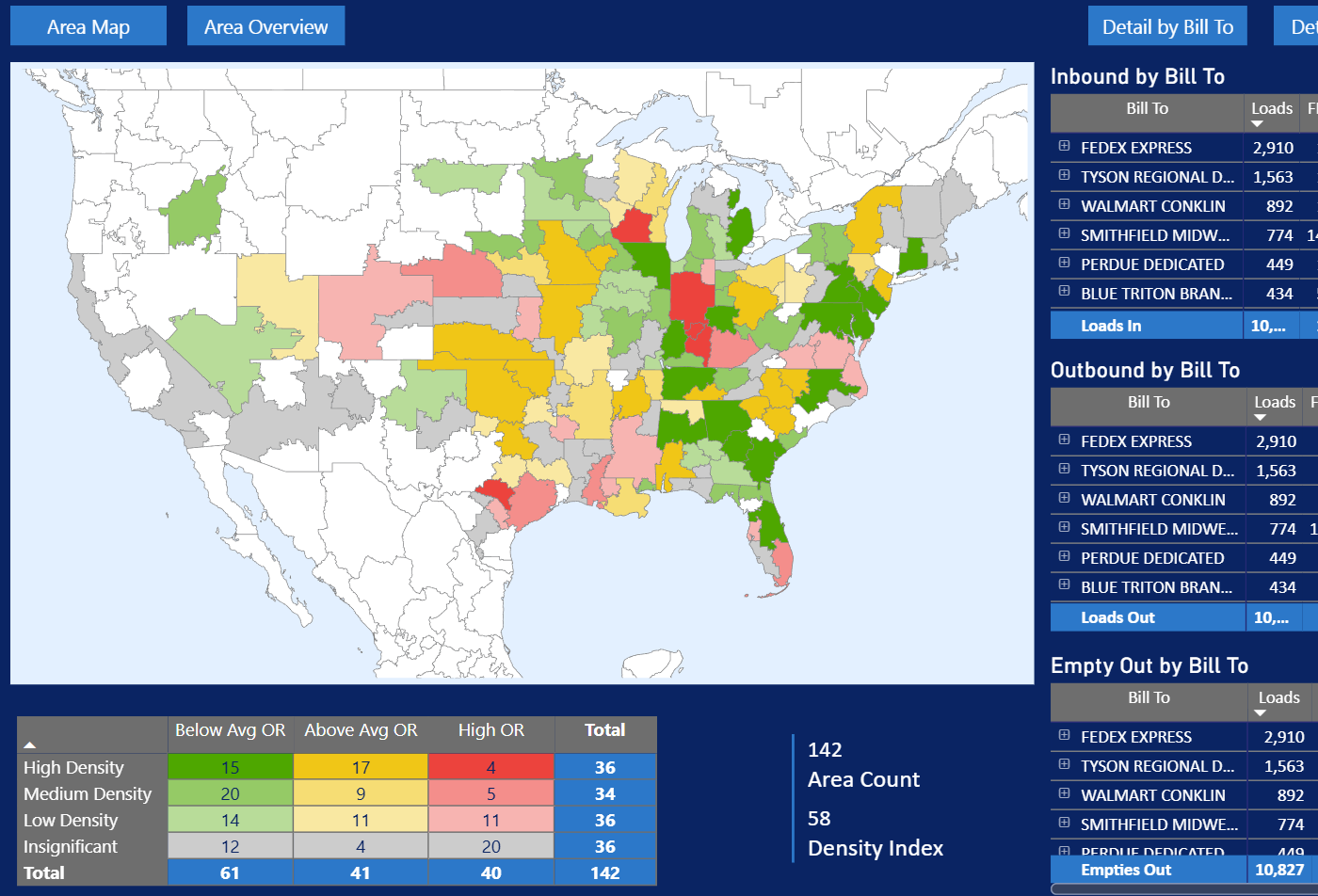
    142
    Operating Areas
    1,108
    Lanes Analyzed
    ~7,000
    Monthly Loads
    58
    Density Index
    93.7%
    Avg OR (Last 6 Mo)
    95.2%
    Avg OR (19 Mo)

    Dedicated Network Overview

    The Dedicated network operates as a contracted, asset-based transportation solution serving a defined customer base with assigned equipment and drivers. Unlike transactional freight, Dedicated volumes are planned, routes are repeatable, and capacity is committed, creating a stable operating environment with strong financial performance. Over the past 19 months, the network has delivered an average Operating Ratio of 95.2%, with recent performance improving to 93.7% over the last six months.

    The network spans 142 operating areas and encompasses over 1,100 analyzed lanes, reflecting geographic reach combined with operational density. Load volumes are balanced: inbound and outbound movements align closely, reducing empty repositioning and supporting efficient asset utilization.

    This combination of financial discipline, network density, and operational predictability positions the Dedicated division as a natural platform for layering additional service tiers, specifically an Expedited offering designed for customers requiring tighter transit windows and enhanced reliability.

    Network Visualization

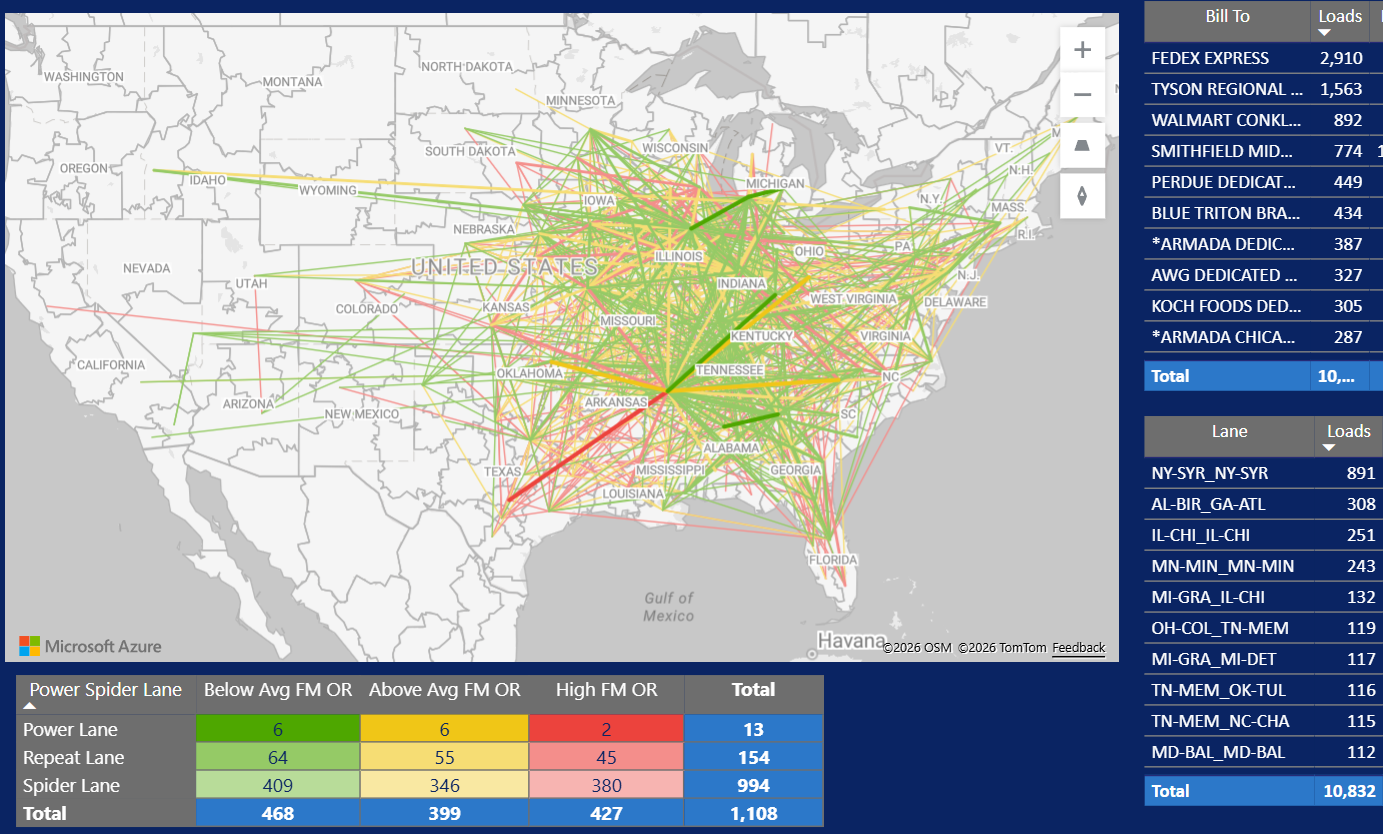
    Dedicated Network Heat Map Dedicated Network Analysis

    Network Characteristics That Support Expedited

    Strong Overall Operating Ratio
    Consistent sub-96% OR performance across 19 months of historical data demonstrates cost discipline and pricing integrity
    Balanced Load Flows
    Near-equal inbound and outbound volumes minimize deadhead and support round-trip efficiency
    Dense Geographic Footprint
    142 operating areas with a Density Index of 58 indicates concentrated activity supporting reliable coverage
    Structured Lane Hierarchy
    13 Power Lanes, 154 Repeat Lanes, and 994 Spider Lanes provide a foundation of high-frequency corridors
    Predictable, Repeatable Operations
    Contracted volumes and consistent schedules reduce variability and improve execution reliability
    Temperature-Controlled Expertise
    Existing cold-chain capabilities align with Expedited requirements for time-sensitive, high-value freight

    Expedited as a Natural Upsell

    The Expedited network should be positioned as a service tier layered onto the existing Dedicated network, not as a standalone offering. The commercial message should lead with reliability, control, and risk reduction rather than speed alone. Because the underlying network is dense and balanced, Expedited volumes can be accommodated with limited incremental complexity, allowing pricing to reflect service certainty and performance.

    For existing Dedicated customers, Expedited represents a natural upgrade path, offering tighter transit commitments on lanes they already ship without requiring new carrier relationships or operational onboarding. For prospects, leading with the stability of the Dedicated platform before introducing Expedited establishes credibility and differentiates the offering from commodity time-definite services.

    Expedited Value Drivers

    • Service Certainty: Defined transit windows backed by network density and operational discipline
    • Risk Reduction: Contracted capacity eliminates spot market exposure during peak demand
    • Operational Continuity: Same equipment, same drivers, same processes, with enhanced commitments
    • Simplified Procurement: Single carrier relationship spanning standard and expedited needs
    • Performance Accountability: Clear SLAs with visibility into execution metrics

    Lane Structure Summary

    13
    Power Lanes
    Highest volume corridors driving core network economics
    154
    Repeat Lanes
    Consistent volume lanes supporting predictable operations
    994
    Spider Lanes
    Network reach extending coverage across operating areas